

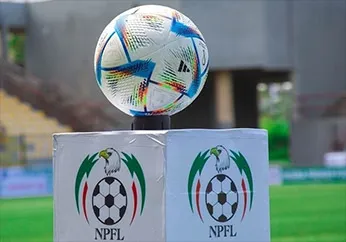
Nigeria’s top-flight football league this Tuesday marks 36 years of professionalism, closing another chapter in a journey that transformed the domestic game from an amateur pastime into a supposedly commercial sporting enterprise.
Professional football officially kicked off in Nigeria on May 12, 1990, when Stationery Stores F.C. hosted Heartland, then known as Iwuanyanwu Nationale, at the waterfront Onikan Stadium, now renamed Mobolaji Johnson Arena.
That historic encounter produced several milestones. Iwuanyanwu Nationale won 2-1 to become the first club to record a victory in Nigeria’s professional era, while defender Ben Iroha etched his name into history as the scorer of the first goal in the professional league.
The launch of professional football came 102 years after England pioneered the concept, following decades of arguments over whether Nigeria possessed the financial and organisational capacity to sustain a professional league.
Ironically, many of the objections raised in the 1950s centred on issues that still challenge the Nigerian game today, poor infrastructure, inadequate funding and weak club administration.
Former NFA chairman Derby Allen had argued in 1953 that Nigerian clubs lacked the facilities and financial strength required for professionalism. At the time, the old King George V Stadium in Lagos, now Mobolaji Johnson Arena, was virtually the only major football ground in the country.
Critics feared clubs would struggle to pay players, maintain stadiums and manage operational costs.
Yet supporters of professionalism insisted it was the only pathway to football development.
Coach Peter ‘Eto’ Amaechina famously argued in 1969 that Nigeria could never attain World Cup standard without adopting professional football. His prediction proved prophetic as Nigeria qualified for its first FIFA World Cup in 1994, barely four years after the professional league began.
The pioneer professional league featured 16 clubs, among them Enugu Rangers, Shooting Stars SC, Bendel Insurance F.C., Enyimba F.C. and Julius Berger F.C.
Administrators also experimented with innovations to encourage attacking football. Between 1990 and 1994, score draws earned two points while goalless draws attracted only one.
Over the years, the league has experienced dramatic highs and lows — from the fairy-tale triumph of Eagle Cement F.C. in 1997 to the shocking relegation of defending champions Shooting Stars in 1999.
The competition has also undergone several administrative transformations, evolving from NFA control to the Nigeria Premier League, then the League Management Company, and now the Nigeria Premier Football League.
As the NPFL clocks 36, the league remains both a symbol of Nigeria’s football passion and a reminder of the unfinished journey towards building a truly stable and commercially vibrant domestic competition.