

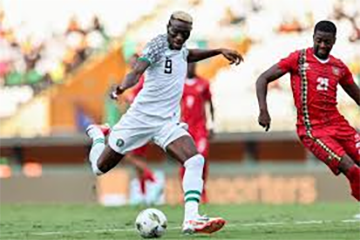
Nigeria’s path to qualification may look comfortable on paper after the Super Eagles were drawn alongside Madagascar, Tanzania and Guinea-Bissau in Group L, but the structure of the campaign means there will be little room for error, especially against Tanzania, the only direct rival likely to challenge for the group’s sole automatic ticket.
With qualification effectively rewarding only group winners, the Super Eagles cannot afford the kind of inconsistency that has complicated several recent African qualifying campaigns. Finishing second could prove fatal, particularly if another nation outside the East African zone tops the group ahead of Tanzania, shutting the door on any secondary qualification route.
That reality immediately places enormous importance on Nigeria’s two matches against Tanzania, widely seen as the Super Eagles’ principal challengers in the group.
While Madagascar and Guinea-Bissau are capable of causing occasional upsets, Tanzania arrive with growing continental credibility after regular appearances at major African tournaments and a rapidly improving domestic football structure. Their physical style, combined with the difficulty of playing in East Africa, could turn the group into a tense two-horse race.
For Nigeria, the danger lies not necessarily in losing outright but in dropping avoidable points away from home, a recurring weakness that has hurt the Super Eagles in past qualification series. Draws against supposedly smaller teams have often transformed straightforward groups into nerve-racking campaigns.
The memory of Nigeria’s shock 2-0 defeat to Madagascar at the 2019 Africa Cup of Nations also serves as a warning against complacency. Guinea-Bissau, meanwhile, have evolved into a stubborn opponent capable of frustrating more fancied sides.
Yet the bigger concern for Nigerian football followers is the absence of a safety net.
Unlike previous qualification formats where strong runners-up still had a realistic pathway, this arrangement leaves little margin for recovery if Tanzania establish early momentum. A single defeat in Dar es Salaam or dropped home points in Uyo could suddenly place Nigeria in a difficult chasing position.
The draw, therefore, places immediate pressure on the Super Eagles to approach the campaign with urgency rather than reputation.
Elsewhere across the continent, several heavyweight clashes emerged from the draw, including the blockbuster Group C showdown between the Côte d’Ivoire national football team and Ghana, while Cameroon face a potentially awkward Group G containing Comoros, Namibia and Congo.
African champions Senegal national football team also face a challenging route in Group J against Mozambique, Sudan and Ethiopia.
But from a Nigerian perspective, the mathematics are brutally simple: top the group or risk watching another major tournament from the sidelines.
And in a continent where away fixtures are increasingly unpredictable, even a seemingly manageable draw offers no guarantees.