

African football heavyweights were handed a mixture of favourable draws and dangerous rivalries after the 2027 Africa Cup of Nations qualifying series was unveiled in Cairo on Tuesday ahead of next year’s historic finals in East Africa.
The qualification campaign, which will determine the 24 teams heading to Kenya, Tanzania and Uganda from June 19 to July 17 next year, produced several blockbuster groups, regional rivalries and tricky qualification scenarios involving the three co-host nations.
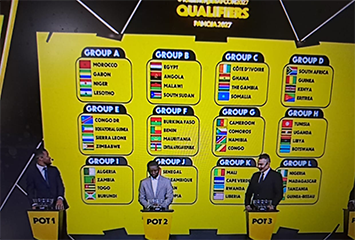
The standout clash emerged in Group C, where defending champions Côte d’Ivoire national football team were paired with arch-rivals Ghana national football team alongside Gambia and Somalia in what many observers immediately identified as the toughest section of the draw.
The rivalry between Côte d’Ivoire and Ghana has produced some of African football’s most memorable contests over the decades, and both countries are expected to engage in another fierce battle for supremacy.
African champions Senegal national football team were drawn in Group J with Mozambique, Sudan and Ethiopia, while 2022 World Cup semi-finalists Morocco national football team headline Group A against Gabon, Niger and Lesotho.
Seven-time African champions Egypt will face Angola, Malawi and South Sudan in Group B, while the Cameroon national football team were handed a potentially awkward Group G containing Comoros, Namibia and Congo.
Comoros, once regarded as minnows, have developed into one of Africa’s fastest-rising football nations following their recent Africa Cup of Nations breakthroughs, making Cameroon’s route less straightforward than it appears on paper.
Group I could also produce intense competition as Algeria national football team takes on Zambia, Togo and Burundi, while Group K, involving Mali, Cape Verde, Rwanda and Liberia, appears one of the most evenly balanced sections in the qualifiers.
Nigeria were drawn in Group L with Madagascar, Tanzania and Guinea-Bissau, reviving memories of Madagascar’s shock victory over the Super Eagles at the 2019 AFCON finals in Egypt.
However, the qualification format for Groups D, H and L introduces a special dimension because Kenya, Uganda and Tanzania are already guaranteed places at the finals as co-hosts.
In those three groups, only the highest-placed team, excluding the co-host nation, will qualify automatically for the tournament.
That arrangement affects Group D, involving Kenya, the South Africa national football team, Guinea and Eritrea; Group H containing Uganda, Tunisia national football team, Libya and Botswana; and Group L featuring Tanzania alongside Nigeria, Madagascar and Guinea-Bissau.
The qualification campaign will be played across three international windows, beginning from September 21 to October 6 this year. The second round of fixtures will take place from November 9 to 17 before the final series of matches between March 22 and 30 next year.
Each national team will play two matches during every qualifying window.
At the end of the series, the top two teams from each group will normally advance to the finals, except in the three groups involving host nations, where the best-performing side apart from the automatic qualifiers will progress.
The 2027 tournament will mark a landmark moment for African football as Kenya, Tanzania and Uganda become the first East African nations to jointly host the continent’s biggest football championship.
The finals are expected to showcase the growing football infrastructure and commercial ambitions of the East African region while also expanding AFCON’s footprint across new territories on the continent.